
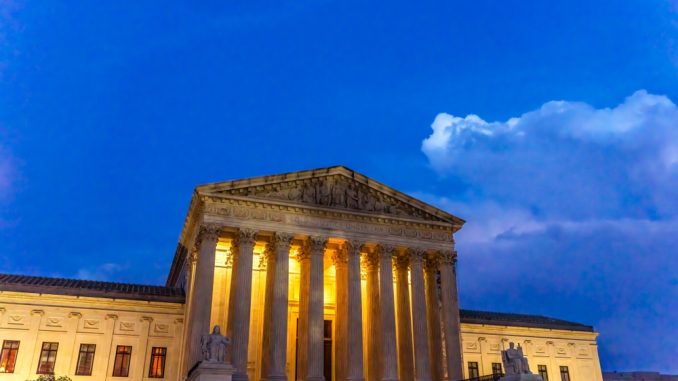
For years conservatives watched biological men dominate women's sports while Democrats cheered.
Finally someone drew a line in the sand.
And the Supreme Court just heard two cases that could save women's sports from this woke insanity.
West Virginia and Idaho defend transgender sports bans in landmark Title IX case
The Supreme Court heard arguments Tuesday in cases that could determine whether states have the constitutional authority to protect women's sports from biological men.
Idaho and West Virginia are defending laws that ban transgender athletes who identify as women from competing on girls' and women's teams.
Lower courts struck down both state bans as unconstitutional violations of Title IX and equal protection.
But Idaho Attorney General Raul Labrador and West Virginia Attorney General JB McCuskey aren't backing down.
"It's about Title IX. It's about equal protection, and it's also about common sense, but mostly it's about protecting women in both academia and on the athletic field," McCuskey told Fox News Digital.
The justices set aside an hour for each case but arguments ran longer as both sides presented their positions.
The Trump administration filed briefs supporting the states and argued Title IX permits sex-based distinctions in athletics.
At stake is whether biological reality matters or whether gender identity trumps everything.
Becky Pepper-Jackson and Lindsay Hecox cases expose radical transgender sports agenda
In Little v. Hecox, Lindsay Hecox – a biological man who sought to compete on women's track and cross-country teams at Boise State University – argued that Idaho's Fairness in Women's Sports Act violated equal protection by excluding transgender women.
West Virginia v. B.P.J. centers on a 15-year-old transgender athlete who identifies as a girl and argued the state's Save Women's Sports Act violated both the Constitution and federal civil rights law.
The Left's position would destroy women's sports as we know them.
Female athletes have testified about the unfairness they face competing against biological males.
Madison Kenyon and Mary Kate Marshall, who competed on women's track teams at Idaho State University, placed behind a transgender athlete in multiple events.
"Stepping on the line, standing next to a male when we're about to race — it's unfair," Marshall said. "I don't know how much — they don't have to put in as much work as I do because of the clear advantages that they have."
In West Virginia, state officials estimate that transgender athlete Becky Pepper-Jackson displaced at least 400 female athletes in standings during the spring 2025 track season alone.
That's 400 girls who lost opportunities because Democrats decided feelings matter more than fairness.
Riley Gaines and conservative athletes celebrate Supreme Court transgender ban review
Former University of Kentucky swimmer Riley Gaines has become one of the most prominent voices defending women's sports after she tied for fifth place with Lia Thomas at the 2022 NCAA championships.
Thomas became the first transgender athlete to win an NCAA Division I title after competing on the men's team for three years.
"Title IX fight hits Supreme Court: 'This is long overdue,'" Gaines said, calling the Supreme Court hearing a pivotal moment.
The justices received dozens of amicus briefs from athletes, coaches, lawmakers and state attorneys general on both sides.
Even the Washington Post editorial board came out against the trans athletes, saying the Supreme Court has the chance to correct "one of the worst excesses of America's cultural revolution."
President Trump signed an executive order in February titled "Keeping Men Out of Women's Sports" that directed federal agencies to rescind funding from schools allowing biological men to compete in women's athletics.
The NCAA immediately changed its policy to restrict women's sports to athletes assigned female at birth.
Twenty-five states already have laws banning transgender athletes from women's sports.
Trump's executive order and Equal Protection Clause frame transgender sports debate
The Trump administration's position is straightforward – federal civil rights law permits sex-based distinctions in athletics.
Idaho and West Virginia say keeping boys out of girls' sports protects female athletes from getting injured and robbed of victories they earned.
The ACLU is fighting for both transgender athletes and claims the state bans unfairly target students based on gender identity.
"Categorically excluding kids from school sports just because they are transgender will only make our schools less safe and more hurtful places for all youth," ACLU attorneys claimed.
That argument ignores the 300 girls who got beat by B.P.J. in athletic competition.
McCuskey predicted the court would rule in favor of the states 9-0 and said that's what common sense demands.
"You make the argument that B.P.J. is being discriminated against, but that belies the argument that all 300 of the other girls that B.P.J. beat in an athletic competition aren't victims," he said.
A ruling in favor of the states could uphold the bans and influence other transgender policy disputes involving bathrooms, locker rooms and sex designation on government documents.
If the court rules against the states, it could limit state power to protect women's sports and broaden interpretations of federal nondiscrimination protections.
The Supreme Court is expected to decide the cases by early summer.
Fifty years after Title IX opened doors for women in athletics, Democrats want to slam those doors shut by letting biological men take over.
The justices have a chance to stop that insanity once and for all.
Sources:
- Ashley Oliver, "Supreme Court weighs states' power to set sex-based rules in school sports," Fox News, January 13, 2026.
- Melissa Quinn, "Supreme Court to step into long-simmering debate over transgender athlete bans," CBS News, January 11, 2026.
- "The transgender athletes cases: an explainer," SCOTUSblog, January 12, 2026.
- "Transgender athlete bans get Supreme Court review in landmark case," ABC News, January 13, 2026.
- "Trump signs executive order banning transgender athletes from women's sports," NPR, February 5, 2025.